
Skip to content

How to play Mensch ärgere Dich nicht

Germany’s classic dice race for 2 to 6 players: move your four pieces once around the board and into your goal before anyone else.

By Updated
Players
2–6
You need
A board, Dice, and Playing pieces
Game length
30–60 min
Difficulty
Easy to learn
Ages
6+
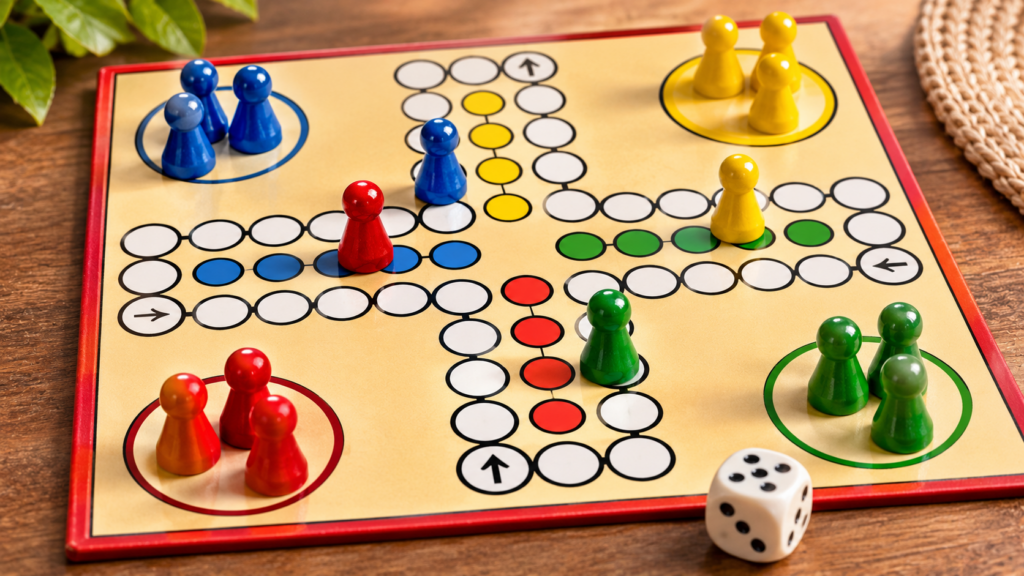
Mensch ärgere Dich nicht board game with red, blue, green and yellow playing pieces and a die on a wooden table.

01 — Goal

Be the first to get all four pieces into the goal

Mensch ärgere Dich nicht is a dice game for two to six players, each playing for themselves. You move your four pieces once around the board and then into the four goal spaces of your colour. The first player with all four pieces in the goal wins. The others play on for the next places.

02 — Setup

One piece on the A space, three on the B spaces

  1. Each player picks a colour and takes the four pieces of that colour.
  2. Put one piece on the A space of your colour. This is your start space on the track. The other three go on the B spaces in your corner.
  3. Everyone rolls the die once. The player with the highest roll starts, then play goes clockwise.

Different starting setup: some families start with all four pieces on the B spaces. The official rules put one piece on the A space from the start.

More or fewer players: the board has a second side for five or six players. With two players, each player can play two opposite colours.

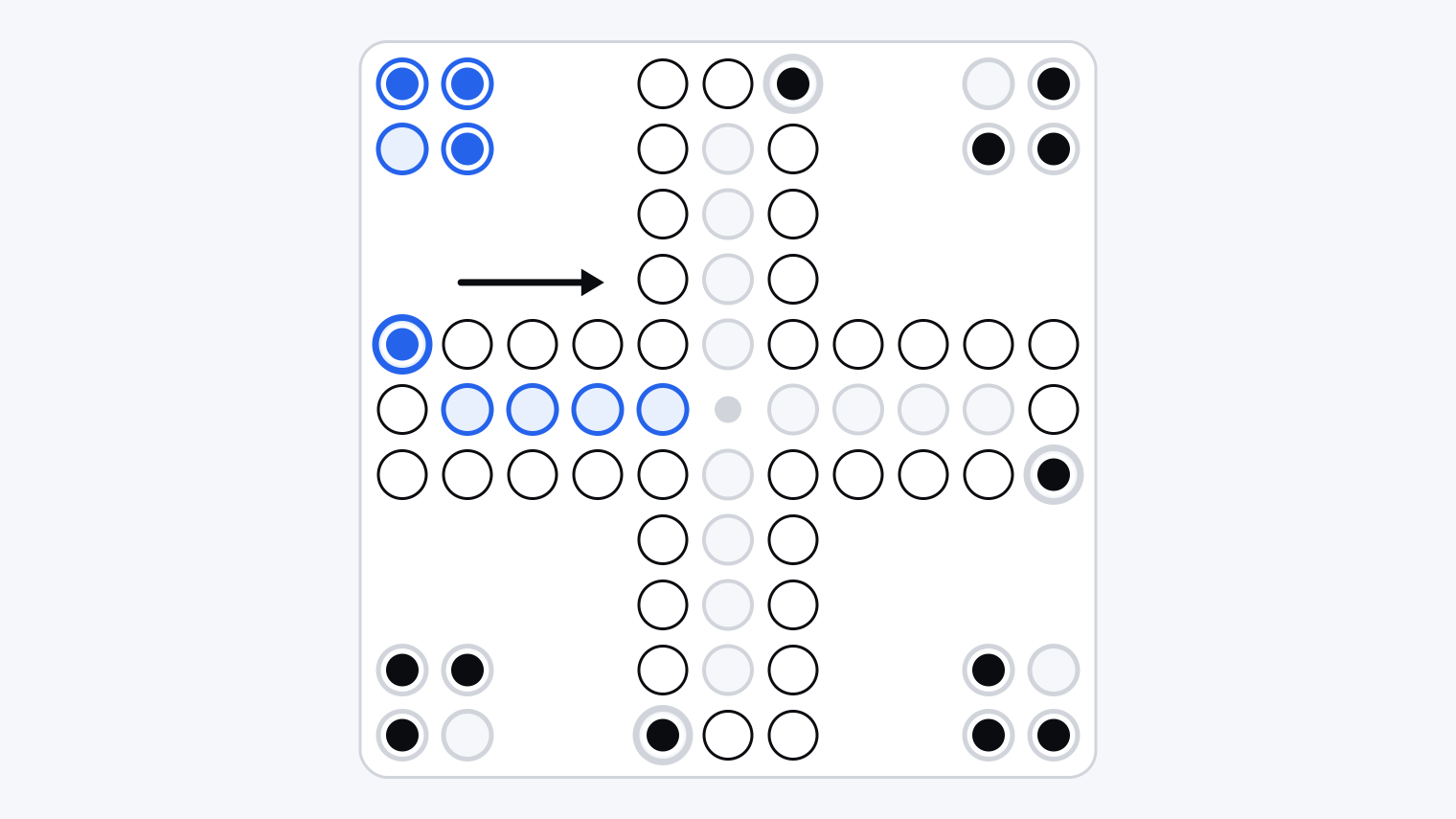
Board from above: one blue piece stands on the blue A space and three more wait on the B spaces in the corner. The arrow shows the direction of play. The four blue goal spaces lead to the centre.

03 — Moving

Roll and move one piece

  1. Roll the die and move one of your pieces on the track exactly that many spaces in the direction of the arrow.
  2. If you have more than one piece out, you choose which one to move. You can’t split a roll between pieces.
  3. You can jump over your own pieces and other players’ pieces, but occupied spaces still count.
  4. Only one piece may stand on each space. If you would land on one of your own pieces, that move isn’t allowed. Move a different piece instead, if you can.

04 — The six

Come out with a 6 and roll again

  • Roll again: after every 6, you roll once more after your move, even several times in a row.
  • Coming out: while you still have pieces on your B spaces, you must use a 6 to put one of them on your A space. If another player’s piece is standing there, it’s captured. If none of your pieces is on the track and you don’t roll a 6, you may only move a piece in your goal that can still reach a free goal space with that number. If that isn’t possible either, it’s the next player’s turn.
  • Clearing your A space: if one of your own pieces is already on your A space, move that piece on with the 6 first. While pieces are waiting on your B spaces, none of your own pieces may stay on your A space. Move it on as soon as you can.
  • All pieces out: once your B spaces are empty, a 6 simply moves a piece six spaces.

If a 6 brings your last piece into the goal, you don’t roll again.

Roll three times: the official rules list this as a variant. If you have no piece on the track and your pieces in the goal can’t move up any further, you may roll three times instead of once. A 6 brings a piece out, and then you roll again as usual.

05 — Capturing

Send other pieces back

If your move ends exactly on a space with another player’s piece, you capture it. It goes back to a B space of its colour and can only come out again with a 6. You can’t capture your own pieces.

You don’t have to capture. It’s up to you whether you move a different piece instead.

Compulsory capturing: this variant is also in the official rules. With this variant, you must capture whenever you can. If you forget, the piece that could have captured goes back to a B space.

06 — Into the goal

Move into your goal after one lap

  1. Once your piece has gone all the way round the track, it doesn’t start another lap. It moves into the goal spaces a to d of your colour.
  2. Each goal space counts as one space. In the goal you may jump over your own pieces and move up with small numbers.
  3. Example: your piece is right in front of your goal spaces. A 1 takes it to space a, a 4 to space d. If you roll a 5, it would have to move past space d. That isn’t allowed, so move a different piece if you can.
  4. You may never move into another player’s goal spaces.
  5. The first player with all four pieces in the goal wins.

No jumping in the goal: in this official variant you may not jump over any piece in the goal. Your last piece can then only move into space a.

07 — Tips

Play smarter

  • Get a second piece out early. Then you can choose which piece to move on many rolls.
  • If another player’s piece is only a few spaces behind you, it could capture you on their next turn, so it’s better to move your threatened piece on.
  • Don’t stop on the A space of a player who still has pieces on their B spaces, because a 6 lets them capture you as they come out.
  • Move pieces into your goal as soon as you can, because nobody can capture them there.

History and name

The name means roughly “Man, don’t get angry”. Josef Friedrich Schmidt invented the game in Munich in 1908. It first came out in 1910, but its breakthrough came in 1914: during the First World War, Schmidt sent the first batch of 3,000 copies to military hospitals as a donation, and the game spread quickly from there. Schmidt Spiele still publishes it today. In January 2024 the company reported more than 100 million copies sold. Like the English game Ludo, it goes back to the Indian game Pachisi.

Play next

All Board games
Rules in 60 seconds

Mensch ärgere Dich nicht

Everyone has four pieces: one on the A space, three on the B spaces. Take turns and move along the arrow. A 6 earns another roll. While pieces wait, a 6 must bring one onto your A space. Landing on another player’s piece sends it back. After one lap, move into your goal. First with all four there wins.

2–6 players 30–60 min