
Skip to content

How to play Monopoly

A property-trading board game: buy streets, collect rent and build houses and hotels. Be the last player who isn't bankrupt and you win.

By Updated
Players
2–6
You need
A board and Dice
Game length
60–180 min
Difficulty
Takes some practice
Ages
8+
Printable PDF
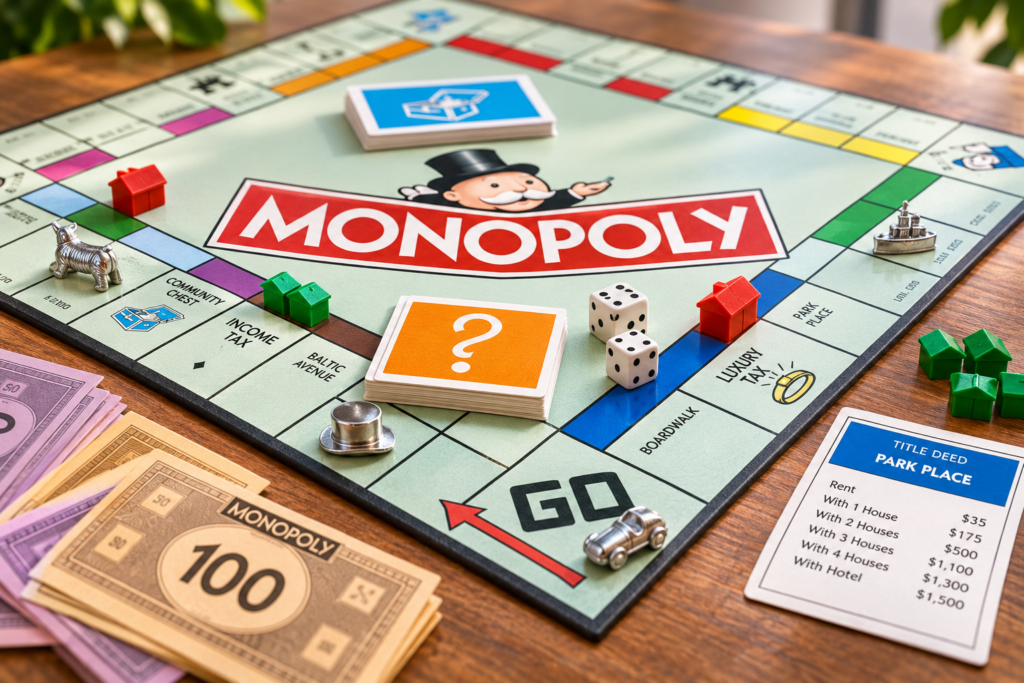
Monopoly board game on a wooden table with colorful houses, two dice, playing tokens, Chance cards and Monopoly money.

01 — Goal

Be the last player who isn’t bankrupt

Buy properties, charge rent when other players land on them and build houses and hotels on complete color sets to raise that rent. A player who can’t pay a debt, even after selling buildings and mortgaging, is bankrupt and out. The last player left in the game wins.

02 — Setup

Pick a Banker and give everyone M1,500

  1. You need the board, 2 dice, the tokens, 28 Title Deed cards, 16 Chance and 16 Community Chest cards, 32 houses, 12 hotels and the play money.
  2. Shuffle the Chance and Community Chest cards and put each pile face down on its space on the board.
  3. Choose a Banker. The Banker runs the Bank (money, Title Deeds, houses, hotels and auctions) and can also play, but keeps their own money separate.
  4. The Banker gives each player M1,500. Everything else stays in the Bank.
  5. Everyone picks a token and puts it on GO.
  6. Everyone rolls both dice. The highest roller goes first, then play passes to the left.

Current Monopoly money is printed with an M symbol. The amounts on this page follow the current US Classic edition (G0009), and the 2017 edition (C1009) uses the same ones. Older US sets use dollars and older UK sets pounds. If your board or cards show different amounts, use those.

03 — A turn

Roll, move clockwise, deal with the space

  1. Roll both dice and move your token that many spaces clockwise.
  2. Do what the space says (see below).
  3. Rolled a double? Take another turn. Roll a double three times in a row and you go straight to Jail instead of moving the third time.
  • Unowned street, railroad or utility: buy it or it goes to auction (next step).
  • Someone else’s property: pay the rent if the owner asks for it in time.
  • Chance or Community Chest: take the top card, do what it says straight away and put it face down at the bottom of its pile. Keep a Get Out of Jail Free card until you use or sell it.
  • Income Tax and Luxury Tax: pay the Bank the amount printed on the space (M200 and M100 on the current board).
  • Free Parking and Just Visiting: nothing happens.
  • Go to Jail: move straight to Jail.

Each time you land on or pass GO, the Bank pays you M200.

Many families put tax and card payments in the middle of the board for whoever lands on Free Parking. That’s a house rule, not an official one, and it makes the game longer.

04 — Property

Buy it, auction it, collect rent

Land on an unowned property and you may buy it at the price on the board space: pay the Bank and take its Title Deed card. If you don’t want it, the Banker must auction it straight away. Everyone can bid, including you. Bidding starts at M10, anyone can raise by as little as M1 and nobody has to wait their turn. When no one raises any more, the highest bidder pays the Bank. If nobody bids at all, no one pays and the Title Deed stays with the Bank.

When someone lands on your property, ask for the rent shown on its Title Deed. If you don’t ask before the next player rolls the dice, they don’t have to pay.

Own every street of one color and you charge double rent on those streets while they have no buildings. A street with houses or a hotel earns the building rent on its Title Deed instead. A mortgaged property earns no rent, but the other, unmortgaged streets in the set still earn the higher rent.

Railroads you ownRent
1M25
2M50
3M100
4M200

Utilities: the player who landed rolls the dice to work out the rent: 4 times the roll if the owner has one utility, 10 times if they own both. If a card sends you to a railroad or utility and names its own rent, follow the card.

05 — Building

Build houses, then hotels, on full color groups

  1. Once you own all the streets of a color set, you can buy houses from the Bank at the price on the Title Deed. You can build whenever you like, even on other players’ turns.
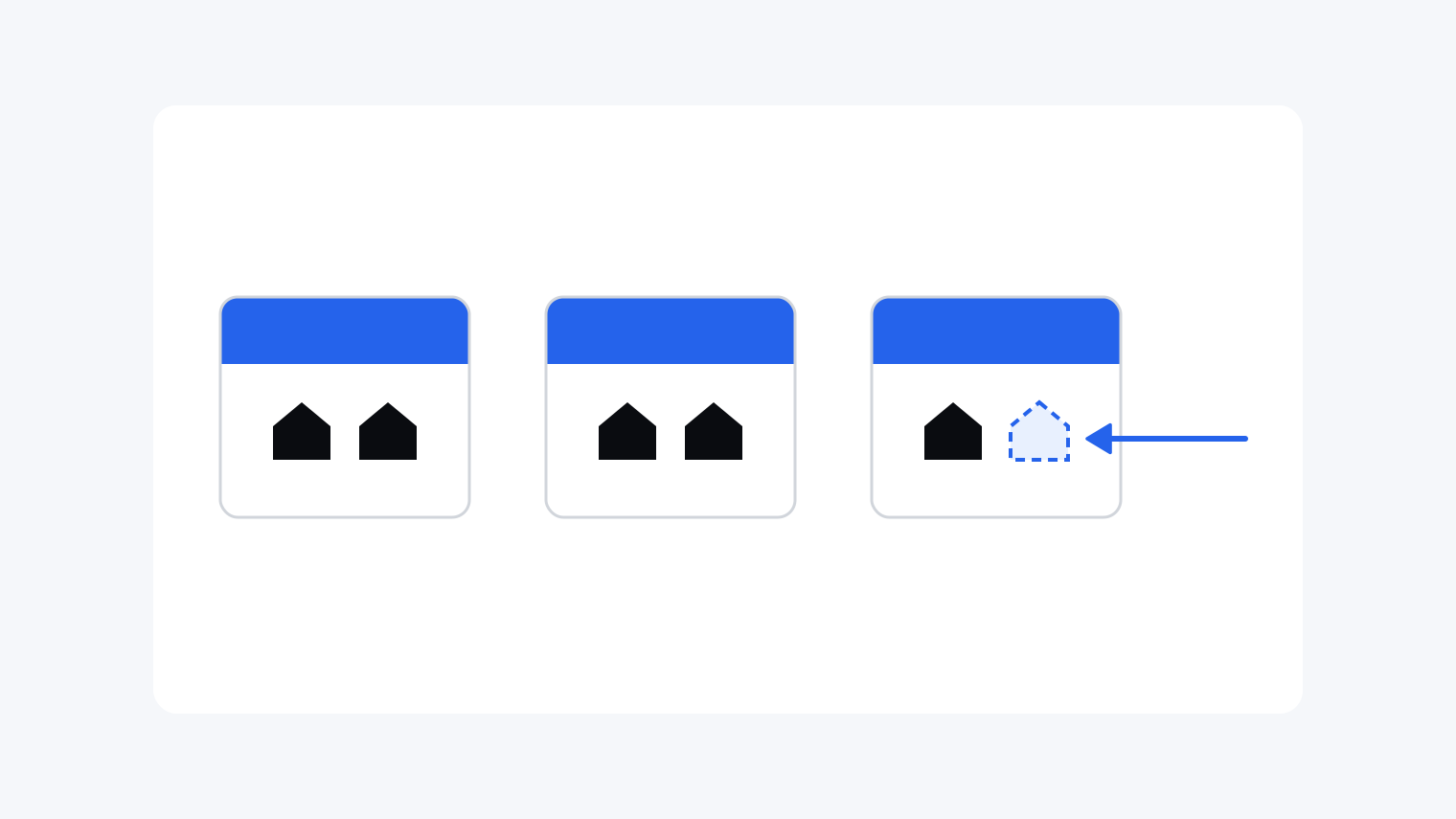
  2. Build evenly: no street in the set can get a second house until every street in it has one, and so on.
  3. The limit is 4 houses per street. When every street in the set has 4, you can upgrade a street to a hotel: return its 4 houses and pay the hotel price on the Title Deed. One hotel per street, and no more houses on it.

Railroads and utilities can’t have buildings. You can’t build on a set while any of its streets is mortgaged.

The Bank has only 32 houses and 12 hotels. When the Bank has no houses left, nobody can buy a house until some come back to the Bank, for example when someone sells houses or returns four houses to build a hotel. The same goes for hotels: once all 12 are in play, you have to wait until one is sold back. If two or more players want the last house or the last hotel, the Banker auctions it: bids start at M10 and rise by at least M1.

Building evenly: three streets of one color set have two, two and one house. The next house must go on the street that has only one.

06 — Jail

Get sent to Jail and get back out

You go to Jail if you land on Go to Jail, draw a card that sends you there or roll a double three times in a row. Move straight to the In Jail part of the corner, don’t collect M200 for passing GO, and your turn ends. If you just land on the corner by a normal roll, you’re Just Visiting.

To get out:

  • Pay M50 at the start of your next turn, then roll and move as normal.
  • Use a Get Out of Jail Free card at the start of your next turn, your own or one bought from another player. Put it at the bottom of its pile, then roll and move.
  • Roll a double. You’re free: move by that roll, and your turn ends there, with no extra roll. You can try on up to three turns.

No double by your third turn? Pay M50 and move by that third roll. While you’re in Jail you can still collect rent, bid in auctions, buy houses and hotels, mortgage and trade.

07 — Money trouble

Mortgage, sell, or go bankrupt

If you owe more than you have in cash, raise money first:

  • Sell buildings: the Bank buys houses back at half their cost. Sell them evenly across the color set. A hotel sells for half its cost and is swapped straight away for 4 houses, which you can then sell evenly too.
  • Mortgage: you can do this at any time. First sell every building in the property’s color set, then turn its Title Deed face down and collect the mortgage value printed on the back. To lift the mortgage, pay the unmortgage cost printed on the Title Deed and turn the card face up again.

Trading: at any time, you can buy, sell or swap properties and Get Out of Jail Free cards with other players for whatever you agree. First sell every building on that color set to the Bank. Buildings can never go to another player. Mortgaged properties can be traded too: the new owner pays off the mortgage straight away or on a later turn. Never lend money to other players or agree not to charge rent.

Still can’t pay? You’re bankrupt and out of the game.

  • Owe another player? Give them all your properties, which will be mortgaged by then, and any Get Out of Jail Free cards. They can pay off the mortgages straight away or later.
  • Owe the Bank? Your properties go back to the Bank, their mortgages are cancelled and they’re all auctioned straight away. Get Out of Jail Free cards go to the bottom of their piles.

Edition difference: in the 2017 rules (C1009) and in older sets, whoever takes over a mortgaged property must decide at once: pay off the mortgage (mortgage value plus 10%), or keep it mortgaged and pay the Bank 10% interest straight away.

Short of time? (variant, not in the current rules) Agree an end time before you start. When it comes, everyone adds up their cash, the printed price of each unmortgaged property, half that price for each mortgaged one, and what they paid for their buildings (a hotel counts together with the four houses it replaced). The richest player wins. Older official rulebooks had a similar Time Limit Game in which everyone is also dealt two Title Deeds at the start.

08 — Scoring

Who gets what

Starting money
M1,500 each
Pass or land on GO
Collect M200
Income Tax / Luxury Tax
Amount on the space (M200 / M100)
Leave Jail early
Pay M50
Railroad rent
M25 / M50 / M100 / M200 for 1 to 4 owned
Utility rent
4x dice roll, or 10x with both
Mortgage a property
Mortgage value on the Title Deed
Lift a mortgage
Unmortgage cost on the Title Deed
Sell a building
Half what you paid
Auction
Bids from M10, raised by M1 or more

09 — Tips

Play smarter

  • Strategy tip: buy almost every property you land on early, because complete color sets are what win games.
  • The orange and red groups get landed on a lot, partly by players coming out of Jail, so they’re worth trading for.
  • Aim for three houses on every street of a set: the third house usually brings the biggest jump in rent (Kentucky Avenue goes from M250 with two houses to M700 with three).
  • Late in the game, staying in Jail can be a good thing: you still collect rent but can’t land on anyone’s hotels.

Where Monopoly comes from

Monopoly grew out of The Landlord’s Game, which Lizzie Magie designed in the early 1900s to show how land monopolies concentrate wealth. She applied for a patent in 1903 and was granted it in 1904. Parker Brothers first published Monopoly in 1935, and Hasbro has owned it since acquiring Parker Brothers in 1991. The US board is named after streets in and around Atlantic City, New Jersey, while the UK board uses London streets.

Why your box might say something different

This page follows the current US Classic edition (G0009). Other sets differ in a few details:

  • Mortgaged property changing hands: in the 2017 edition (C1009) and older sets, the new owner pays 10% interest at once or pays off the mortgage immediately.
  • Older rulebooks (for example 1997, 2001 and 2007) let auctions start at any amount, and the 2001 German rules work out utility rent from the roll that brought you there. Older US rulebooks also let the owner claim rent until the second player after you has rolled.
  • Taxes: most US sets before 2008 let you pay Income Tax as $200 or 10% of your total worth, and Luxury Tax was $75. Always pay what your board shows.
  • Speed Die: some sets include an extra Speed Die with its own rules. In the 2007 rules, everyone starts with an extra $1,000 when you use it. It isn’t part of the Classic game described here.

MONOPOLY is a trademark of Hasbro. This page explains the rules in our own words.

Play next

All Board games
Rules in 60 seconds

Monopoly

Everyone starts on GO with 1,500 in play money. Roll, move clockwise and buy unowned properties. If you don’t buy, they’re auctioned. Pay rent on other players’ properties. Own a complete color set to build houses and hotels. Collect 200 for passing or landing on GO. Can’t pay your debts? You’re bankrupt. The last player left wins.

2–6 players 60–180 min