
Skip to content

How to play Azul

Azul is a tile-laying game for 2–4 players in which you collect tiles from the Factory displays, fill your pattern lines and score as many points as possible for your wall.

By Updated
Players
2–4
You need
A board
Game length
30–45 min
Difficulty
Easy to learn
Ages
8+
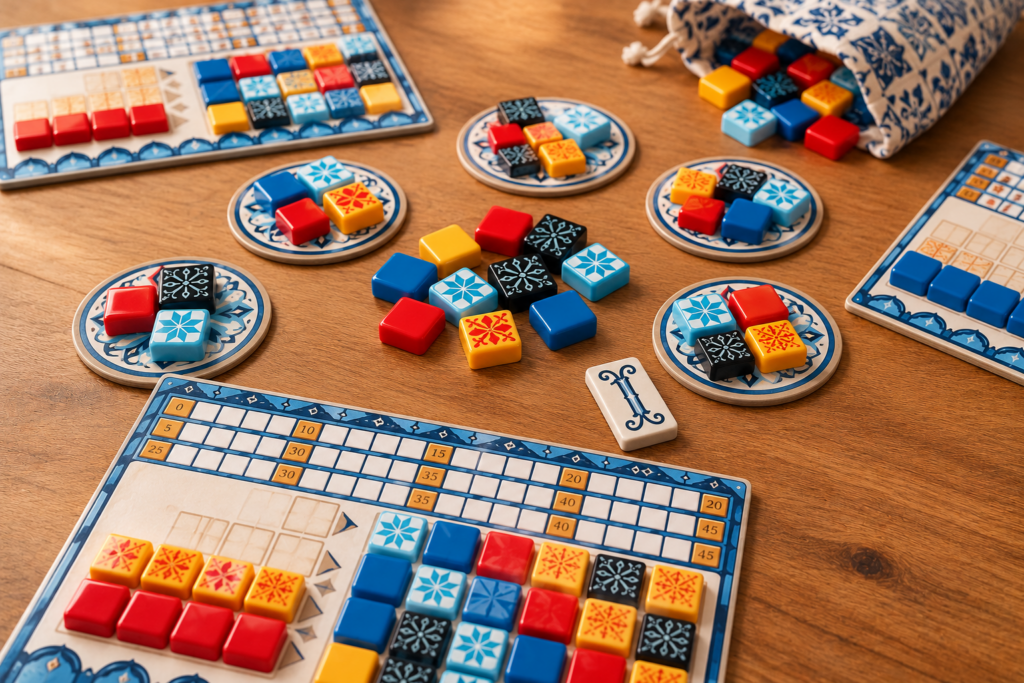
Azul board game with colorful tiles on factory displays and player boards. Additional tiles and the starting player marker lie in the center of the wooden table.

01 — Goal

Score the most points with your wall

You collect tiles and place them on the wall of your player board. Every tile you place on your wall scores points. You score especially well when other tiles are already directly next to it, horizontally or vertically. At the end of the game, you earn bonus points for complete rows, columns and colors.

02 — Setup

Put 4 tiles on each Factory display

  1. Each player places a player board in front of them with the colored wall face up. Everyone plays with the same side.
  2. Place your scoring marker on the 0 space of your score track.
  3. Arrange Factory displays in a circle around the center of the table: 5 for two players, 7 for three and 9 for four.
  4. Fill the bag with all 100 tiles, 20 in each of the five colors.
  5. The player who most recently visited Portugal takes the starting player marker and fills each Factory display with exactly 4 tiles drawn from the bag without looking.

Return any unused player boards, scoring markers and Factory displays to the box. Keep the box lid within reach: this is where you collect discarded tiles during the game.

03 — Taking tiles

Take all tiles of one color

Every round starts with the Factory offer phase. The player with the starting player marker places it in the center of the table and takes the first turn. Play then continues clockwise.

On your turn, you must take tiles; there is no passing. You have two options:

  • From a Factory display: Take all tiles of one color. Push the remaining tiles from that display into the center of the table.
  • From the center of the table: Take all tiles of one color from the center. If you are the first player to take tiles from the center this round, you also take the starting player marker. Place it on the leftmost free space of your floor line.

Example: A Factory display holds 2 red tiles, 1 blue tile and 1 yellow tile. You take the two red tiles, and the blue and yellow tiles move to the center. Whoever is first to take from the center this round also gets the starting player marker, even if they only want that one yellow tile.

The starting player marker costs you points on your floor line just like a tile. In return, you start the next round.

The Factory offer phase ends as soon as all Factory displays and the center of the table are empty.

04 — Placing tiles

Fill one pattern line

Place the tiles you just took in just one of your five pattern lines, as many as will fit. You may also place all of them on your floor line. The top pattern line has 1 space, the bottom one has 5.

  • Fill the line from right to left.
  • A pattern line only ever holds one color. If it already has tiles, you can only add tiles of the same color.
  • If a color is already on the matching wall row to the right, you can no longer place that color in this pattern line.
  • Once all its spaces are filled, the pattern line is complete.

The floor line

Tiles you can't or don't want to place in a pattern line go on your floor line, from left to right. They count as broken and cost you points at the end of the round. If your floor line is full, any further tiles go into the box lid.

Example: You take 4 yellow tiles. Your third pattern line is empty, and there is no yellow tile on the third row of your wall yet. You place 3 tiles there, which completes the line. The fourth tile goes on your floor line.

05 — Wall & scoring

Move tiles to your wall and score points

Once all tiles have been taken, the Wall-tiling phase follows. All players do it at the same time. Go through your pattern lines from top to bottom:

  1. If a pattern line is complete, move its rightmost tile to the space of the same color in the wall row next to it.
  2. You score points for this tile immediately.
  3. Finally, put the remaining tiles from all complete pattern lines into the box lid.

Incomplete pattern lines stay where they are for the next round.

Points for a new wall tile

  • If no other tile touches it horizontally or vertically, you score 1 point.
  • If tiles are linked to the new tile horizontally without gaps, you score 1 point for each tile in this horizontal group, including the new one.
  • If tiles are linked to it vertically without gaps, you also score 1 point for each tile in this vertical group, again including the new one.

So the new tile counts in both directions. Because you work from top to bottom, a tile you have just placed already counts for the tiles that follow.

Example: On the third row of your wall, the first two spaces are filled, and there is a tile directly above the third space. If you now place a tile on that third space, it belongs to a horizontal group of 3 tiles and a vertical group of 2. That scores 3 + 2 = 5 points.

Floor line penalties

At the end of the Wall-tiling phase, for each tile on your floor line you lose the points shown above its space. Your score never drops below 0.

Floor line spacePoints per tile
1st and 2nd space−1
3rd, 4th and 5th space−2
6th and 7th space−3

Example: Your floor line holds the starting player marker and 2 tiles. You lose 1 + 1 + 2 = 4 points.

Then put the tiles from your floor line into the box lid. Place the starting player marker in front of you instead.

06 — Game end

New round or final scoring

If nobody has filled a horizontal row of their wall with 5 tiles yet, prepare the next round:

  1. The player with the starting player marker fills each Factory display again with exactly 4 tiles from the bag.
  2. If the bag is empty, this player refills it with all the tiles from the box lid and fills the remaining displays.
  3. Then the new round begins with the Factory offer phase.

In rare cases, the bag and the box lid are both empty at the same time. The round still starts as usual, even if not all Factory displays are filled.

End of the game and bonus points

The game ends right after the Wall-tiling phase in which at least one player has completed a horizontal row of their wall with 5 tiles. That round's floor line penalties still count. Then everyone scores bonus points:

  • +2 points for each complete horizontal row
  • +7 points for each complete column
  • +10 points for each color with all 5 tiles on your wall

Example: You have one complete horizontal row, one complete column and all 5 yellow tiles on your wall. That gives you 2 + 7 + 10 = 19 bonus points.

The player with the most points wins. In a tie, the tied player with the most complete horizontal rows wins. If it's still a tie, the victory is shared.

07 — Variant

Gray wall: choose your own spaces

For a slightly different game, everyone turns their player board to the gray wall side at the start. All rules stay the same, with this one exception:

  • When you move a tile to your wall, you choose a free space in the matching wall row yourself.
  • Each color may appear only once in each horizontal row and once in each column of your wall.

Special case: If there is no legal space left for the rightmost tile of a complete pattern line, immediately place all the tiles of that pattern line on your floor line.

Example: Your fourth pattern line is complete with red. On the fourth row of your wall, only the spaces in columns 2 and 5 are still free, but both columns already have a red tile. All 4 red tiles go to your floor line.

So when you fill a pattern line, think ahead about where that color still fits on your wall.

08 — Scoring

Who gets what

Wall tile with no neighbors
1 point
Wall tile with neighbors
Points for linked tiles horizontally and vertically, counting the new tile in each direction
Floor line
−1, −1, −2, −2, −2, −3, −3 (up to −14)
Complete horizontal row
+2 points at game end
Complete column
+7 points at game end
All five tiles of one color
+10 points at game end

09 — Tips

Play smarter

  • Try to place new tiles next to tiles already on your wall, because a tile on its own scores only 1 point.
  • Keep an eye on the center of the table: if you wait too long, you'll often have to put lots of tiles on your floor line.
  • Fill the short top pattern lines early so your wall gets its first tiles quickly.
  • Think about columns and complete colors too, because they're worth 7 and 10 bonus points at the end.

About Azul

Azul is a tile-laying game by Michael Kiesling. It was published by Plan B Games and is now part of the Next Move Games line. The game is about azulejos, the painted ceramic tiles of Portugal. As the game’s story goes, King Manuel I visited the Alhambra in southern Spain and was so impressed by its Moorish tiles that he had his own palace in Évora decorated in a similar way. In Azul, you design the walls of this palace.

This guide covers the rules of the base game Azul. Later games in the Azul series have their own rules.

Play next

All Board games
Rules in 60 seconds

Azul

Take turns picking all tiles of one color from a Factory display or the center. Place them in one pattern line; extra tiles cost points. At the end of the round, each complete pattern line moves one tile to your wall. Adjacent tiles score more. A complete horizontal wall row ends the game after that round. Most points wins.

2–4 players 30–45 min