Where Canasta comes from
Canasta was invented in 1939 in Montevideo, Uruguay. Its name is Spanish for “basket”. The game reached New York in 1949 and became hugely popular in the 1950s, first in the United States and then in Europe.
A rummy game for two teams with two decks and jokers: meld cards of the same rank, build canastas of at least seven cards and be the first team to reach 5,000 points.
 By Lena Berger
Updated
01 — Basics
Canasta is played by four people in two teams of two. Partners sit opposite each other and play together.
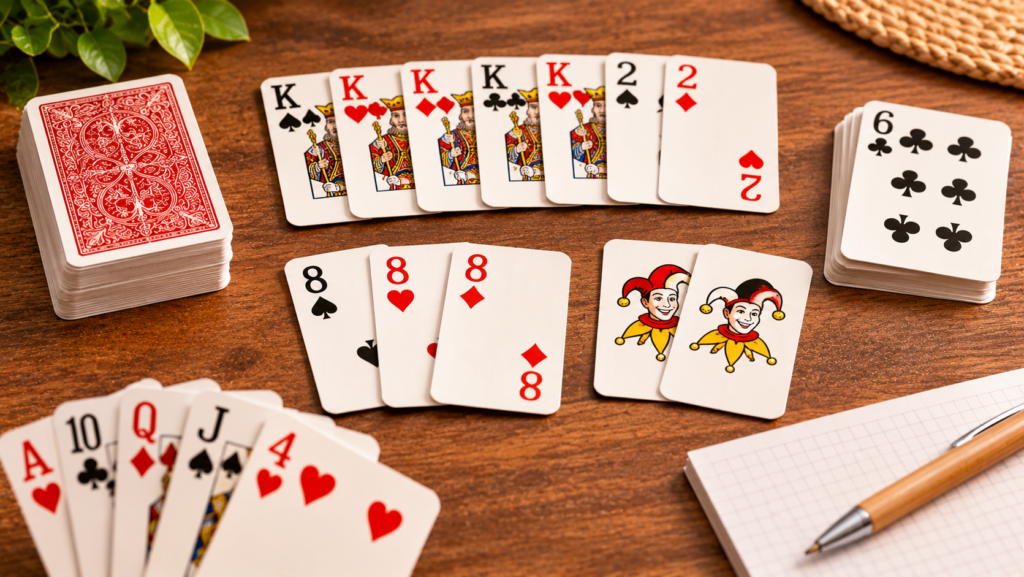
During the game you collect cards of the same rank, for example 8s. The suit doesn’t matter, and runs like 6-7-8 don’t count. Once you have three 8s, you can lay them face up on the table in front of your team. This is called melding, and the cards on the table are a meld. Only your team’s first meld of each hand has to reach a minimum score (step 5).
Over the next turns, you and your partner add more 8s to it. Once the meld has seven cards, it’s a canasta. You can keep adding 8s to it after that.
Canastas are what the game is about. Each one earns your team a big bonus. Going out means getting rid of all your cards, which ends the current round, called a hand. Nobody in your team can go out until you have at least one canasta. You play several hands and add up the points. The first team to reach 5,000 points wins.
Natural and wild cards: all cards from 4 to ace are natural cards. Jokers and 2s are wild cards: they can stand in for any natural card in a meld. Every meld needs at least two natural cards and may contain no more than three wild cards. A natural canasta has no wild cards and earns a 500-point bonus. A mixed canasta contains one to three wild cards and earns 300. Stack a finished canasta neatly into one pile, with a red card on top if it’s natural and a black card on top if it’s mixed. The 3s are special cards (step 4).
02 — Setup
The two piles: you normally draw from the face-down stock. The face-up discard pile is where everyone puts one card at the end of their turn. Under certain conditions you can take the whole discard pile instead of drawing (step 6).
03 — A turn
Every turn has the same three parts:
Example: your team already has three 8s on the table. You draw the 8 of clubs and add it to your 8s. You also hold two jacks and a 2, so you lay them out as a new meld: two jacks with the 2 as a wild card. Finally you discard a 5 you don’t need.
Melding is optional. Even if you could meld, you may keep the cards in your hand for later. On many turns, especially at the start, you’ll just draw and discard.
Two more rules for melding:
04 — Card values
| Card | Points |
|---|---|
| Joker (wild) | 50 |
| 2 (wild) | 20 |
| Ace | 20 |
| King, queen, jack, 10, 9, 8 | 10 |
| 7, 6, 5, 4 | 5 |
| Black 3 | 5 |
Card values matter twice: for your team’s first meld (step 5) and when you count the points at the end of a hand (step 8).
05 — First meld
In every hand, your team’s first meld must be worth a minimum number of points. To check, add up the card values from step 4.
How many points you need depends on your team’s total on the score sheet, from the hands you’ve already played. Points from the current hand don’t count yet. The further ahead your team is, the more you need:
| Your team’s total on the score sheet | Minimum for the first meld |
|---|---|
| Below 0 (negative) | 15 |
| 0 to 1,495 | 50 |
| 1,500 to 2,995 | 90 |
| 3,000 or more | 120 |
Example for the first hand: at the start of the game every team has 0 points, so in the first hand you always need 50. You hold three kings (30 points). That isn’t enough on its own. If you also hold three queens (30 points), that makes 60, so you lay out both melds in the same turn.
Example for a later hand: your team finished the first hand with −40 points because you still had lots of cards in your hands. Your total is now below 0, so in the second hand you only need 15. Three 5s are enough.
06 — Discard pile
The discard pile grows with every turn. Instead of drawing one card from the stock, you can take the whole discard pile, and with it lots of cards for your melds. You may only do this if you can meld its top card straight away:
Example: your team has already made its first meld. A queen is on top of the discard pile and you hold two queens. You lay out the three queens as a meld, then pick up the rest of the pile and add it to your hand. After that you carry on as usual: meld more if you like and discard one card.
You can never take the pile when a wild card or a black 3 is on top. And if you have only one card left in your hand, you can’t take a discard pile that consists of a single card.
Frozen pile: sometimes the pile is frozen. Then a stricter rule applies: you can only take it with two natural cards from your hand that match the top card. Wild cards and your team’s melds don’t help. The pile is frozen for everyone as soon as a wild card lies in it. Whoever discards a wild card lays it crosswise, so everyone can see the pile is frozen. A red 3 turned up at the start freezes it too. And for your team, the pile stays frozen until you’ve made your first meld. The stricter rule protects a large pile. That’s why players sometimes discard a wild card on purpose, so the other team can’t take the pile easily.
07 — Going out
When you go out, the hand ends for everyone.
Example: your team has a canasta of kings, and you hold two 6s and a 9. You draw another 6, lay out the three 6s and discard the 9. Your hand is empty, so you’re out and the hand is over.
Going out concealed: if you meld your whole hand in one turn, including a canasta, without having melded before in that hand and without adding to your partner’s melds, your team gets 200 points for going out instead of 100.
When the stock runs out: play continues only while players take the discard pile. You must take it if its top card fits one of your team’s melds and the pile isn’t frozen. As soon as someone would have to draw from the empty stock, the hand ends. If the last card of the stock is a red 3, the player who draws it lays it out and the hand ends at once, without melding or discarding.
08 — Counting points
At the end of each hand, both teams count their points. There are four kinds:
All bonuses are listed under Who gets what.
Example: your partner went out. Your team has a mixed canasta of five kings and two 2s, a meld of three 8s and one red 3. You still hold a 5 and a jack.
| Your team | Points |
|---|---|
| Card points: five kings and two 2s | 90 |
| Card points: three 8s | 30 |
| Bonus for the mixed canasta | 300 |
| Bonus for going out | 100 |
| Bonus for the red 3 | 100 |
| Minus points: the 5 and the jack in your hand | −15 |
| Total | 605 |
If your team hasn’t melded anything by the end of the hand, your red 3s count as minus points instead.
Write both totals down and start the next hand, with the deal passing to the left. The first team to reach 5,000 points wins. If both teams reach 5,000 in the same hand, the team with the higher total wins.
09 — Variants
Everything above describes the classic game for four players in two teams. With fewer players, a few rules change:
10 — Scoring
11 — Tips
Canasta was invented in 1939 in Montevideo, Uruguay. Its name is Spanish for “basket”. The game reached New York in 1949 and became hugely popular in the 1950s, first in the United States and then in Europe.