How to play Rummy
The classic draw-and-discard card game: collect sets and runs, lay them on the table and be the first to get rid of all your cards.
 By Lena Berger
Updated
- Players
- 2–6
- You need
- A deck of cards and Pen & paper
- Game length
- 20–60 min
- Difficulty
- Easy to learn
- Ages
- 8+
01 — Goal
Be the first to empty your hand
Collect your cards into sets and runs, lay them on the table, and get rid of all your cards before anyone else. The winner of each hand scores the cards the others are still holding.
02 — Setup
Deal by the number of players
Use one 52-card deck without jokers. Deal one card at a time, starting with the player to the dealer's left.
| Players | Cards each |
|---|---|
| 2 | 10 |
| 3 or 4 | 7 |
| 5 or 6 | 6 |
Turn the next card face up to start the discard pile. The rest go face down as the stock. The player left of the dealer starts, and play moves clockwise.
German Rummy: In Germany, Rummy is usually played as Rommé, with two decks and jokers. You'll find its rules in German Rummy (Rommé).
03 — Melds
Sets and runs
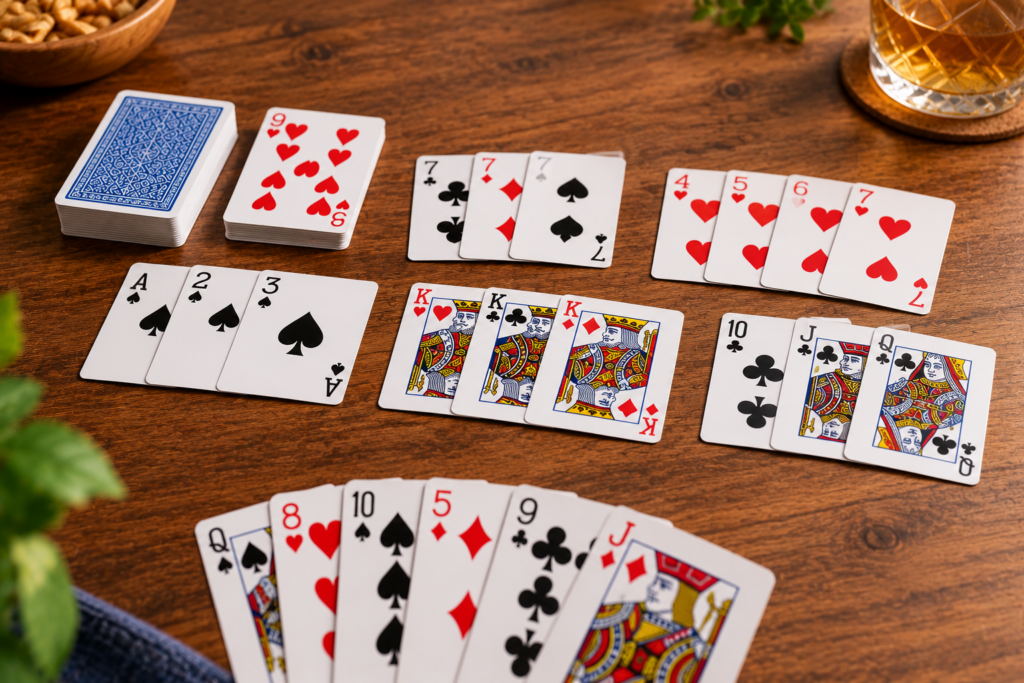
- Set: three or four cards of the same rank, such as three 7s.
- Run: three or more cards in a row in the same suit, such as the 4, 5 and 6 of hearts.
The ace is low: A-2-3 is a run, but Q-K-A is not.
Many groups let the ace count high as well (Q-K-A); an ace left in a hand then counts 15 points instead of 1. Runs that go round the corner (K-A-2) are rarely allowed. Agree before you start.
- 7 of spades
- 7 of hearts
- 7 of diamonds
- 4 of hearts
- 5 of hearts
- 6 of hearts
- 7 of hearts
- Ace of clubs
- 2 of clubs
- 3 of clubs
04 — A turn
Draw, meld, lay off, discard
- Draw one card: the top card of the stock or the top card of the discard pile.
- Meld (if you want): lay one set or run from your hand face up on the table. Many groups allow more than one meld per turn.
- Lay off (if you want): add cards from your hand to any meld on the table, yours or someone else's.
- Discard (if you still have cards): place one card face up on the discard pile. You can't discard the card you just took from the discard pile straight back.
Example: Another player has melded the 4, 5 and 6 of hearts. On your turn, you can lay off the 3 or the 7 of hearts on that run.
If the stock runs out and the next player doesn't want the top card of the discard pile, turn the discard pile over without shuffling to make a new stock.
Some groups shuffle the discard pile before turning it into a new stock.
05 — Going out
Play your last card to win the hand
The hand ends as soon as a player has no cards left, whether by melding, laying off or discarding the last card.
Some groups require you to finish by discarding your last card. Many groups also play that if you go out in a single turn without having melded or laid off any cards before ("going rummy"), your score for that hand is doubled.
06 — Counting points
Score what the others still hold
Everyone else adds up the cards left in their hand, and the winner scores the total.
| Card | Points |
|---|---|
| King, queen, jack | 10 |
| Number cards 2–10 | Face value |
| Ace | 1 |
Example: You go out. One opponent still holds a king and a 7 (17 points), another an ace and a 4 (5 points). You score 22 points for the hand.
Agree before you start on a target score or a number of hands. The highest total wins.
07 — Scoring
Who gets what
- King, queen or jack left in a hand
- 10 points
- Number card 2–10 left in a hand
- Face value
- Ace left in a hand
- 1 point
- Going out
- Scores the total of all other hands
- Going rummy (variant)
- Double points for the winner if they haven't melded or laid off anything before.
08 — Tips
Play smarter
- Early on, get rid of high cards you can't use: a king left in your hand adds 10 points to the winner's score.
- Watch the discard pile to see which cards your opponents pick up and avoid feeding their melds.
- Lay off cards on other players' melds: it empties your hand faster.
- Keep pairs and two cards in sequence, since one more card turns them into a meld.