Skip to content

How to play Rummikub

A tile game for 2 to 4 players: lay out your number tiles in groups and runs, rearrange the table and be the first to empty your rack.

By Updated
Players
2–4
You need
A Rummikub set and Pen & paper
Game length
30–60 min
Difficulty
Easy to learn
Ages
7+
Printable PDF Score sheet
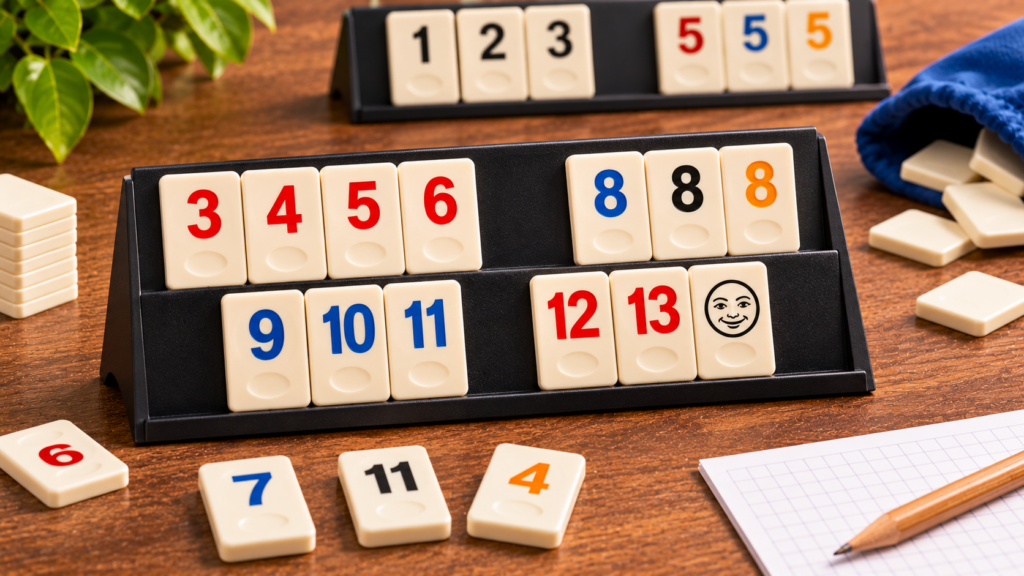
Rummikub game with colorful numbered tiles and a joker on black tile racks, surrounded by additional tiles and a score sheet on a wooden table.

01 — Goal

Get rid of all your tiles first

Rummikub is played by two to four players with number tiles instead of cards. The tiles show the numbers 1 to 13 in four colours: black, red, blue and orange (yellow instead of orange in some editions). Each tile exists twice, and there are also two jokers, 106 tiles in total.

Everyone starts with 14 tiles on their own rack. Bit by bit, you lay them out on the table as groups and runs. The first player to get rid of all their tiles wins the game. Everyone else loses points for the tiles left on their rack.

02 — Setup

Take 14 tiles each

  1. Turn all tiles face down on the table and mix them well.
  2. Each player draws one tile. Whoever has the highest number starts, then play goes clockwise. Put the tiles back and mix again.
  3. Each player takes 14 tiles and stands them on their rack so nobody else can see them.
  4. The remaining tiles stay face down in the middle of the table as the pool.

03 — Groups & runs

Lay out groups and runs

At the end of every turn, all tiles on the table must form valid combinations of at least three tiles. There are two kinds:

  • Group: three or four tiles with the same number in different colours. Each colour may appear only once, so a group has no more than four tiles.
  • Run: three or more tiles of the same colour with consecutive numbers. The 1 is always the lowest tile and the 13 the highest, so 12-13-1 isn’t a run.

Example: the table shows which tiles belong together. Red 7, blue 7 and black 7 form a group. Red 7, blue 7 and another red 7 don’t, because red appears twice. Orange 3, 4, 5 and 6 form a run. Orange 3, orange 4 and blue 5 don’t, because they aren’t all the same colour.

CombinationTiles
Group: validRed 7 · Blue 7 · Black 7
Not a group: red twiceRed 7 · Blue 7 · Red 7
Run: validOrange 3 · Orange 4 · Orange 5 · Orange 6
Not a run: two coloursOrange 3 · Orange 4 · Blue 5
Run with a joker as the blue 10Blue 9 · Joker · Blue 11

A joker can stand in for any tile. It takes the number and colour the combination needs. For example, blue 9, joker, blue 11 is a run, and the joker counts as the blue 10.

04 — First meld

Your first meld needs 30 points

Before you can play tiles in any other way, you have to make your first meld. It must be worth at least 30 points. Each tile counts its number, and a joker counts as the tile it replaces.

  • All tiles for your first meld must come from your own rack. You may not use tiles that are already on the table.
  • You may lay out several groups and runs at once to reach 30.
  • If you can’t reach 30, draw a tile from the pool instead. Your turn is then over.
  • From your next turn on, you may also add to the combinations on the table and rearrange them (step 6).

Example: you hold red 8, black 8 and orange 8. That’s only 24 points. You also have blue 2, 3 and 4, which make another 9. Together that’s 33, so you lay out both combinations at once.

Your first meldPoints
Group: Red 8 · Black 8 · Orange 824
Run: Blue 2 · Blue 3 · Blue 49
Total33

05 — A turn

Lay out tiles or draw one

On your turn you have two options:

  1. Lay out at least one tile from your rack. You can start new groups or runs, or add tiles to combinations on the table. Until you’ve made your first meld, this has to be your 30-point first meld (step 4).
  2. Draw one tile from the pool if you can’t or don’t want to lay anything out. Your turn ends straight away, so you can’t play the tile you just drew until your next turn.

Then it’s the turn of the player on your left. At the end of your turn, the table may only hold valid groups and runs, with no loose tiles.

Example: a run of blue 4, 5 and 6 is on the table, and you’ve already made your first meld. You add your blue 7 to the run and lay out a new group of three 11s. Your turn is over, and you don’t draw a tile.

Your turnTiles
On the table beforeBlue 4 · Blue 5 · Blue 6
From your rackBlue 7 · Red 11 · Blue 11 · Black 11
On the table after: runBlue 4 · Blue 5 · Blue 6 · Blue 7
On the table after: new groupRed 11 · Blue 11 · Black 11

Time limit: the official English rules give each player 1 minute per turn. If you take too long, draw one tile and your turn ends. If you’ve already started rearranging and can’t finish, put every table tile back where it was, take your own tiles back and draw three tiles as a penalty. If you all agree beforehand, you can play with more time or without a time limit.

Possible rule difference: the German-language rules allow 2 minutes per turn. If you run over, any tiles that aren’t part of a valid group or run go back to your rack, and you draw three penalty tiles. Agree before you start which time limit you use.

06 — Rearranging

Rearrange the tiles on the table

After your first meld, you can use every combination on the table, not just your own. On your turn you may take them apart and put them together in new ways, as long as you lay out at least one tile from your rack. For example:

  • Add: put a tile at the end of a run or add the fourth colour to a group.
  • Take away: take the fourth tile of a group, or the end tile of a run with at least four tiles, and use it in a new combination.
  • Split: insert a matching tile to break a long run into two.

At the end of your turn, every tile on the table must be part of a valid group or run again. Tiles from the table never go onto your rack.

Example of splitting: the red run 4, 5, 6, 7, 8 is on the table, and you hold a red 6. You split the run into red 4, 5, 6 and red 6, 7, 8. Both runs are valid, and you’ve got rid of a tile.

SplittingTiles
On the table beforeRed 4 · Red 5 · Red 6 · Red 7 · Red 8
From your rackRed 6
On the table after: run 1Red 4 · Red 5 · Red 6
On the table after: run 2Red 6 · Red 7 · Red 8

Example of taking away: a group of red, blue, black and orange 9 is on the table. You hold the black 10 and 11. You take the black 9 out of the group and lay out the run black 9, 10, 11. The group still has three 9s, so it stays valid.

Taking awayTiles
On the table beforeRed 9 · Blue 9 · Black 9 · Orange 9
From your rackBlack 10 · Black 11
On the table after: groupRed 9 · Blue 9 · Orange 9
On the table after: new runBlack 9 · Black 10 · Black 11

Retrieving a joker: once you’ve made your first meld, you may swap a joker on the table for the tile it stands for. That tile can come from your rack or from the table. In a group of two tiles and a joker, either of the two missing colours works. You must use the joker again on the same turn in a new combination, and as always you must lay out at least one tile from your rack. The joker never goes onto your rack.

Example of retrieving a joker: the run blue 9, joker, blue 11 is on the table, so the joker stands for the blue 10. You’ve already made your first meld and hold the blue 10, the red 4 and the black 4. You put your blue 10 in the joker’s place, and the run stays valid. Then you lay out the joker straight away with your two 4s as a new group. There it counts as a blue or orange 4.

Retrieving a jokerTiles
On the table beforeBlue 9 · Joker · Blue 11
From your rackBlue 10 · Red 4 · Black 4
On the table after: runBlue 9 · Blue 10 · Blue 11
On the table after: new groupRed 4 · Black 4 · Joker

07 — Game end

Empty your rack and count the points

As soon as a player lays out their last tile, they call “Rummikub!” and win the game. The others add up the numbers on the tiles still on their racks, with a joker counting 30. Each of them scores minus that amount, and the winner scores the total of everyone else’s amounts.

Example: Anna lays out her last tile. Ben still has 3, 7 and 10 on his rack and scores −20. Clara still has 5, 12 and a joker and scores −47. Anna scores 20 + 47 = 67 points.

PlayerPoints
Ben: 3 + 7 + 10−20
Clara: 5 + 12 + joker (30)−47
Anna: rack empty, 20 + 47+67

When the pool is empty: if nobody has emptied their rack by then, keep playing. If you can’t lay anything out, you pass. Once nobody can lay out anything more, the player with the lowest total on their rack wins. Everyone else scores minus the difference between their total and the winner’s, and the winner scores the sum of these differences.

Example: the pool is empty and nobody can play. Anna has 4 points left on her rack, Ben 10 and Clara 15. Anna wins. Ben scores −6, Clara −11, and Anna scores 6 + 11 = 17 points.

Player (left on rack)Points
Anna (4): lowest total, 6 + 11+17
Ben (10): 10 − 4−6
Clara (15): 15 − 4−11

The official English rules suggest playing as many games as there are players. Whoever has won the most games is the overall winner, and in a tie the higher score wins. You can also agree on your own number of games.

Possible rule difference: in the German-language rules, a joker left on your rack counts 25 points instead of 30. Agree on the value before you start.

08 — Scoring

Who gets what

Emptying your rack (“Rummikub!”)
Total of all the other players’ rack values
Tiles left on your rack
Minus the numbers on the tiles
Joker left on your rack
−30 points (possible rule difference: −25 in the German-language rules)
Pool empty and nobody out
Lowest rack total wins, the others lose the difference to the winner

09 — Tips

Play smarter

  • Sort your tiles by colour and number on your rack, so you can spot groups and runs at a glance.
  • After your first meld, look at the whole table, because a tile that seems useless often fits once you split a run or move a tile.
  • Lay out high tiles when you can, because they cost you the most if someone else empties their rack first.
  • Keeping a joker on your rack can pay off, but it costs you 30 points if someone else empties their rack first.

Where Rummikub comes from

Rummikub was invented by Ephraim Hertzano, who was born in Romania and moved to Israel after the Second World War. He and his family made the first sets by hand. By the late 1970s the game was a bestseller in the United States, and in 1980 it won Germany’s Spiel des Jahres (Game of the Year) award. More than 50 million copies have been sold.

Play next

All Board games
Rules in 60 seconds

Rummikub

Everyone gets 14 tiles. On your turn, lay out groups (same number, different colours) or runs (consecutive numbers, one colour). If you can’t, draw a tile. Your first meld needs 30 points from your own tiles. After that you may rearrange the table. Jokers replace any tile. The first player to empty their rack wins.

2–4 players 30–60 min