About Flip 7
Flip 7 was designed by Eric Olsen. It’s published by The Op in the United States and by Kosmos in Germany. In 2025 it was nominated for the Spiel des Jahres, Germany’s Game of the Year award.
A quick press-your-luck card game for 3 to 18 players where you collect as many points as you can without getting the same number twice.
 By Lena Berger
Updated
01 — How it works
In every round you collect number cards. After each card you decide: take another one, or stop? The numbers on your cards add up. That’s your score for the round.
The catch: if you get a number you already have, you bust. Then you score nothing at all for that round.
Example: Ben gets an 8. He could stop now and keep 8 points. Instead he takes another card and gets a 5. Now he has 13 points. If he takes another card and it’s another 8 or 5, he loses all his points for this round. With any other number he can carry on.
If you collect seven different numbers, that’s a Flip 7. The round ends at once for everyone, and you score 15 extra points.
You play several rounds and write the scores down. The game ends after the round in which someone reaches 200 points. The player with the most points wins.
This guide follows the official rules of the original edition by The Op. The current German edition by Kosmos uses the same rules.
02 — Setup
If an action card comes up during the deal, pause and carry it out straight away (step 5). Then carry on dealing. Because of this, not everyone may have a number card after the deal.
03 — A turn
After the deal, the dealer asks each player who is still in the round, in turn:
You can stay as soon as you have at least one card in front of you. Play carries on around the table until nobody is left in the round or someone gets a Flip 7.
Good to know:
04 — The cards
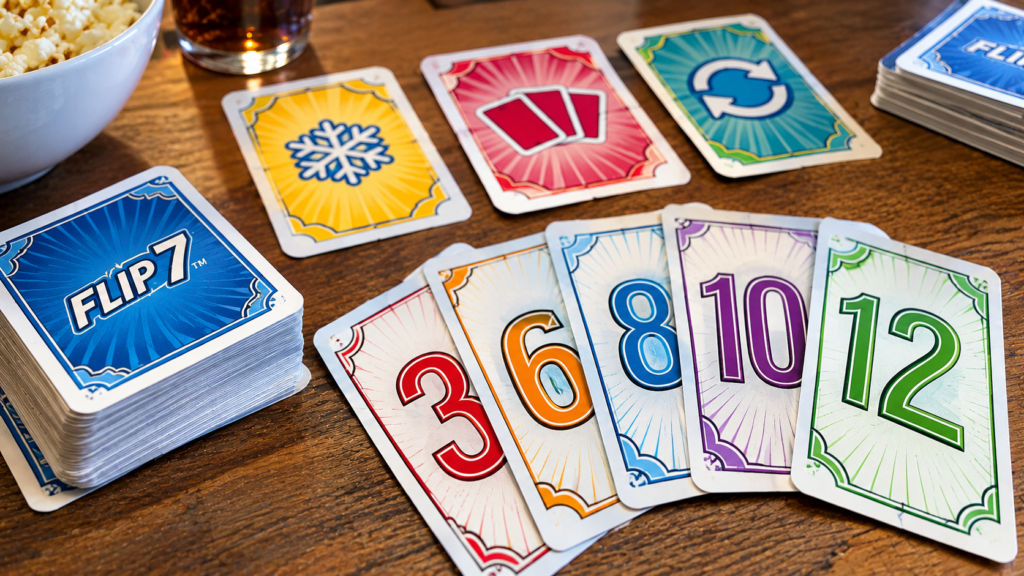
Flip 7 has 94 cards of three kinds:
If you play with more than 18 people, it’s best to add the cards of a second deck.
05 — Action cards
You get action cards just like any other card. You don’t keep a Freeze or a Flip Three, though. You decide who it hits: anyone still in the round, including yourself. If you’re the last player still in the round, you have to use it on yourself.
A Freeze makes a player stop at once, and they keep the points they have so far. For example, Lea only has 6 points so far. Tom gets a Freeze and gives it to Lea. Lea has to stop and scores 6 points this round.
Flip Three makes a player take the next three cards, one at a time. For example, Tom gives Flip Three to Lea, who has 3, 8, 10 and 12 in front of her. Lea gets a 5, then +4 and then an 8. She already has an 8, so she busts.
The details:
A Second Chance saves you from busting once. For example, Mia has 4, 9 and 11 and a Second Chance in front of her. She gets a second 9. She discards the 9 and the Second Chance and stays in the round.
06 — Points
At the end of the round, everyone who hasn’t busted counts their points:
If you busted, you score 0. Write everyone’s points down and add them to their running total.
Example: Sam stays with 11, 5 and 12 and the +4 card. He scores 11 + 5 + 12 = 28, plus 4, so 32 points. Clara gets a Flip 7 with 0, 1, 3, 5, 7, 9 and 12 and also has x2 and +6. Here’s how she counts:
| Clara’s points | Total |
|---|---|
| Number cards: 0 + 1 + 3 + 5 + 7 + 9 + 12 | 37 |
| x2 doubles the number cards | 74 |
| Modifier +6 | 80 |
| Flip 7 bonus +15 | 95 |
07 — Game end
The game ends after the round in which at least one player reaches 200 points or more. The player with the most points wins, even if several players have reached 200. If there’s a tie for the most points, everyone plays more rounds until there is a single winner.
08 — Scoring
09 — Tips
Flip 7 was designed by Eric Olsen. It’s published by The Op in the United States and by Kosmos in Germany. In 2025 it was nominated for the Spiel des Jahres, Germany’s Game of the Year award.