
Skip to content

How to play Roulette

In roulette, a ball spins around a wheel with 37 numbers. You bet on where it will stop: one number, several numbers or a color. Bets on fewer numbers win less often but pay more.

By Updated
Players
1+
You need
Betting layout, Chips, Roulette ball, and Roulette wheel
Difficulty
Easy to learn
Ages
18+
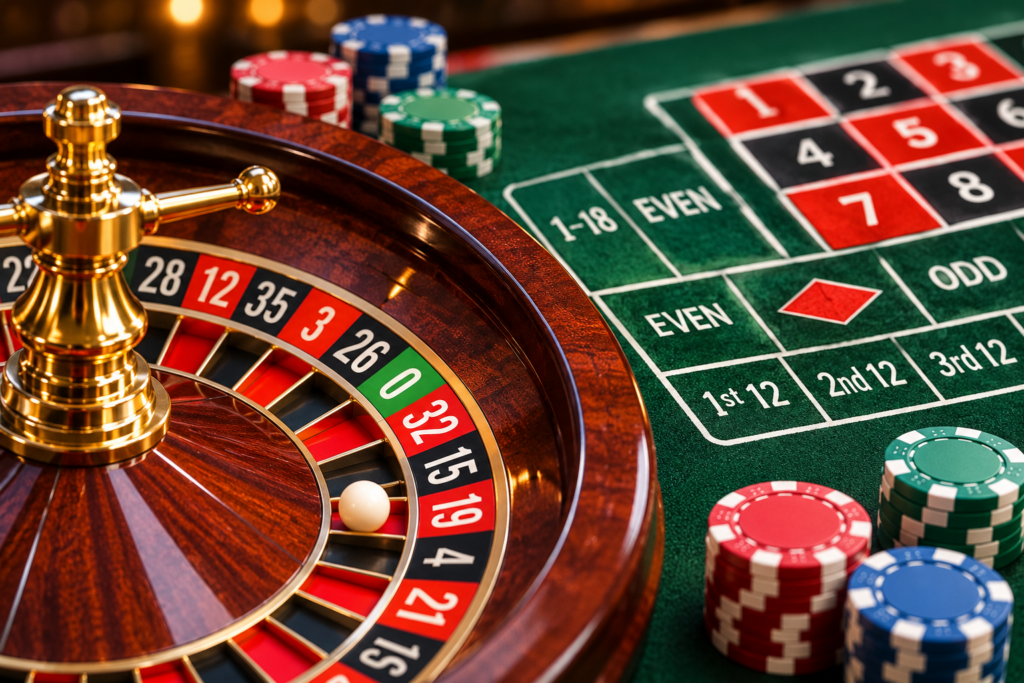
Wooden roulette wheel with a white ball next to a green betting layout showing numbers and betting options, surrounded by red, blue and green casino chips.

01 — Goal

Bet on the pocket where the ball stops

A European roulette wheel has 37 numbered pockets: the numbers 1 to 36 and a single zero. Of the numbers 1 to 36, 18 are red and 18 are black. The zero is green and counts as neither red nor black.

You bet on a single number or on a group of numbers. If the ball stops in a pocket your bet covers, you win at that bet’s fixed payout. If not, the dealer takes your chips.

Roulette is a pure game of chance. No strategy can reliably predict where the ball will land.

02 — Setup

Wheel, ball, betting layout and chips

  • Wheel and ball: the wheel spins one way while the dealer sends the ball around the outer track in the opposite direction.
  • Betting layout: the cloth on the table where you place your chips. The numbers 1 to 36 sit in 12 rows of three (1-2-3, 4-5-6 and so on up to 34-35-36), which also gives three long columns. The zero sits at the head of the layout, above 1, 2 and 3. The boxes for the outside bets run along the edge.
  • Chips: where your chip sits on the layout decides which number or group of numbers you are betting on.
  • Dealer (croupier): runs the game, watches the bets, spins the wheel and ball, and collects and pays the bets.

Every table sets its own minimum and maximum bet and shows them at the table. Check them before you play.

03 — Bets

Inside bets and outside bets

Inside bets go on the numbered part of the layout and cover one number or a small group. They win less often but pay more.

  • Straight up (1 number): chip inside the box of one number, for example 17.
  • Split (2 numbers): chip on the line between two neighboring numbers, for example 17 and 18, or 17 and 20.
  • Street (3 numbers): chip on the outer line at the end of a row of three, for example 16, 17 and 18.
  • Corner (4 numbers): chip on the point where four numbers meet, for example 17, 18, 20 and 21.
  • Six line (6 numbers): chip on the outer line where two rows meet, so it covers both rows, for example 16 to 21.

Zero can also be part of some inside bets, for example a split on 0 and 1.

Outside bets go in the boxes around the numbers and cover 12 or 18 numbers at once.

  • Red or black (18 numbers): all red numbers or all black numbers.
  • Odd or even (18 numbers): all odd or all even numbers from 1 to 36.
  • Low or high (18 numbers): 1 to 18 or 19 to 36.
  • Dozen (12 numbers): 1 to 12, 13 to 24 or 25 to 36.
  • Column (12 numbers): one of the three columns, for example 1, 4, 7 and so on up to 34. The chip goes in the box at the end of the column.

What zero does: zero is not red or black, not odd or even, not low or high, and not part of any dozen or column. Under the standard rules, every outside bet therefore loses when the ball lands on zero. Some casinos soften this for red or black, odd or even and low or high with La Partage or En Prison (see Variants). Dozens and columns lose either way. A bet that covers zero, such as a straight-up bet on 0, wins.

04 — The spin

Bet until the dealer calls “No more bets”

  1. Place your chips on the layout.
  2. The dealer spins the wheel and sends the ball around the outer track in the opposite direction. While the ball is still circling, you can usually keep betting.
  3. The dealer calls “No more bets” (in French “Rien ne va plus”). From now on nobody may place, move or remove chips.
  4. The ball drops into a pocket. That is the winning number.
  5. The dealer announces the number and puts a marker on it on the layout.
  6. The dealer collects the losing bets first and then pays the winning ones. Then the next round begins.

05 — Payouts

What each bet pays

BetNumbers coveredPays
Straight up135 to 1
Split217 to 1
Street311 to 1
Corner48 to 1
Six line65 to 1
Dozen122 to 1
Column122 to 1
Red or black181 to 1
Odd or even181 to 1
Low or high181 to 1

“35 to 1” means you win 35 times your stake and also get your stake back.

Example: you put 10 chips on 17 and the ball lands on 17. You win 10 × 35 = 350 chips and get your 10 chips back, so 360 chips in total. If you put 10 chips on red instead and the ball lands on a red number, you win 10 chips. Together with your stake, you get 20 chips back.

A higher payout does not make a bet better. A single number covers 1 of the 37 pockets, so its chance on every spin is 1 in 37. That does not mean it comes up once every 37 spins. Red covers 18 of the 37 pockets, so its chance on every spin is just under half, but it pays only 1 to 1. A fair payout for one number would be 36 to 1, but the casino pays 35 to 1. That gap comes from the zero and is the house edge: about 2.70 percent of every stake on a single-zero wheel, whatever standard bet you choose.

Every spin is independent. If red has come up five times in a row, black is no more likely on the next spin. No betting system or sequence of bets removes the house edge.

06 — Variants

American and French roulette

American roulette has 38 pockets: 1 to 36, 0 and 00. The usual payouts stay the same, but the extra green pocket raises the house edge on the standard bets to about 5.26 percent. Under the standard rules, outside bets lose on both 0 and 00. One bet is special to this wheel: the first five bet on 0, 00, 1, 2 and 3. It pays 6 to 1 and has a house edge of about 7.89 percent, the highest on the table.

French roulette and special zero rules: some casinos, especially at French roulette tables, apply one of two special rules to even-money bets (red or black, odd or even, low or high) when zero comes up. Sometimes you can choose between them. The casino’s house rules tell you which one applies.

  • La Partage: you get half your stake back and lose the other half.
  • En Prison: your stake is locked for the next spin. If it wins then, you get it back without winnings. If it loses, it is gone. What happens on a second zero is up to the casino.

With La Partage the house edge on these bets drops to about 1.35 percent. With En Prison it depends on what happens if zero comes up again and lies between about 1.35 and 1.39 percent. All other bets follow the standard rules.

07 — Tips

Play smarter

  • Before the dealer calls “No more bets”, check that each chip sits exactly on the number, line or corner you mean.
  • Choose a single-zero wheel when you can, because the extra 00 on an American wheel almost doubles the house edge.
  • Set a spending limit before you start and never raise your bets to win back what you have lost.

Play responsibly

Roulette is gambling, not a skill game you can master with practice. If you play for real money, you can lose it. Before you start, set a budget and a time limit, and only bet what you can afford to lose. The minimum age is often 18, but it can be higher depending on the country, the region or the casino. In the state-run casinos in Bavaria, for example, you must be 21 to play.

Play next

All Casino games

Playing Roulette for real money? See our separate Casino Guides (18+).

Rules in 60 seconds

Roulette

Put chips on one number, several numbers, or red or black. The dealer spins the wheel and the ball. After “No more bets,” you can’t change anything. If the ball stops on your number or color, you win. One number returns 36 times your bet, red or black twice your bet. On the green zero, red or black usually loses.

1+ players